
U.S. President Donald Trump has signed a bill ending the longest government shutdown in American history, bringing temporary relief to federal agencies and financial markets. The late-night Oval Office signing followed a planned dinner with JPMorgan CEO Jamie Dimon and several top Wall Street executives, underlining the administration’s effort to stabilize investor sentiment.
According to Reuters, it remains unclear how quickly federal operations will resume full functionality after the shutdown. Markets are now awaiting the release of delayed macroeconomic data, including September’s nonfarm payrolls — expected to be one of the first catch-up indicators. Analysts say the numbers could strengthen the case for a potential rate cut after a series of soft private-sector surveys. Yet the White House has warned that several key releases, including October’s employment and CPI reports, may never be published, creating an unusual information gap for traders.
In times of heightened volatility and inconsistent data, experts emphasize the importance of working with the best forex broker, ensuring access to stable liquidity and fast order execution. According to financial analysts at Traders Union, market participants are increasingly seeking brokers with proven resilience during periods of uncertainty — a trend reflected in the latest update of the Union’s global broker ranking released this week.
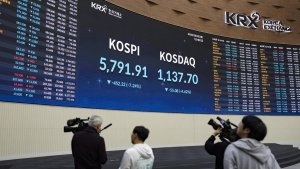
Asian markets react as currency pressures build Asian equity markets moved mostly higher on Thursday, with Japan’s Topix index hitting a fresh record after new highs on the Dow Jones, FTSE 100 and STOXX 600. Gold prices paused their recent rally, while currency markets remained under pressure. The Japanese yen hovered near intervention territory, briefly pushing past 155 per U.S. dollar earlier in the week, prompting a reminder from the Ministry of Finance that authorities are monitoring the situation closely. The yen also slid to a record low of 179.49 per euro.
Prime Minister Sanae Takaichi reaffirmed her preference for maintaining low interest rates and called for close coordination with the Bank of Japan. BOJ Governor Kazuo Ueda echoed this stance, telling parliament that the central bank remains focused on achieving moderate inflation supported by wage growth.
In Australia, an unexpected surge in October employment caused traders to scale back expectations of a rate cut, while a drop in ANZ Bank shares — trading ex-dividend — weighed on the local index. Global attention now shifts to a series of corporate earnings, including results from Tencent, SMIC, Siemens and Disney, which may offer deeper insight into global consumer trends and ongoing U.S.–China technology tensions.
Earlier, we reported on how the U.S. shutdown affected the crypto market.